EMR Patient Portals Are Breaking the Care Experience


- The Bridge Team
- November 24, 2021
EMR Patient Portals Are Breaking the Care Experience
Key Takeaways
- Fragmented EMR patient portals damage care delivery by forcing patients through multiple logins, redundant data entry, and disconnected systems that create frustration and reduce engagement before clinical care even begins.
- Unified patient intake platforms improve patient satisfaction scores from 3.7 to 4.6 out of 5 while achieving 70% pre-visit completion rates and 85% time-of-service collection rates.
- Digital empathy is not a contradiction—well-designed healthcare technology amplifies human connection by freeing staff from repetitive tasks and giving patients control over when and how they interact with their care team.
- Healthcare organizations can reduce vendor licensing costs by up to 65% through platform consolidation while simultaneously improving both patient experience and staff efficiency.
Update Date: January 29, 2026
When a patient can’t check in smoothly, they arrive stressed. When they can’t pay their bill easily, they avoid scheduling their next visit. When intake forms ask the same questions three different ways across three different systems, they feel like no one is listening.
This is what happens when access breaks. And when access breaks, care breaks.
The tools meant to connect patients to their healthcare are instead creating barriers. EMR patient portals were supposed to open a digital front door. Instead, most have built a maze.
When Access Breaks, Care Breaks
Major EMR vendors like Epic, Cerner, and eClinicalWorks have responded to increased demand for virtual care by acquiring smaller companies and stacking their technologies onto existing systems.
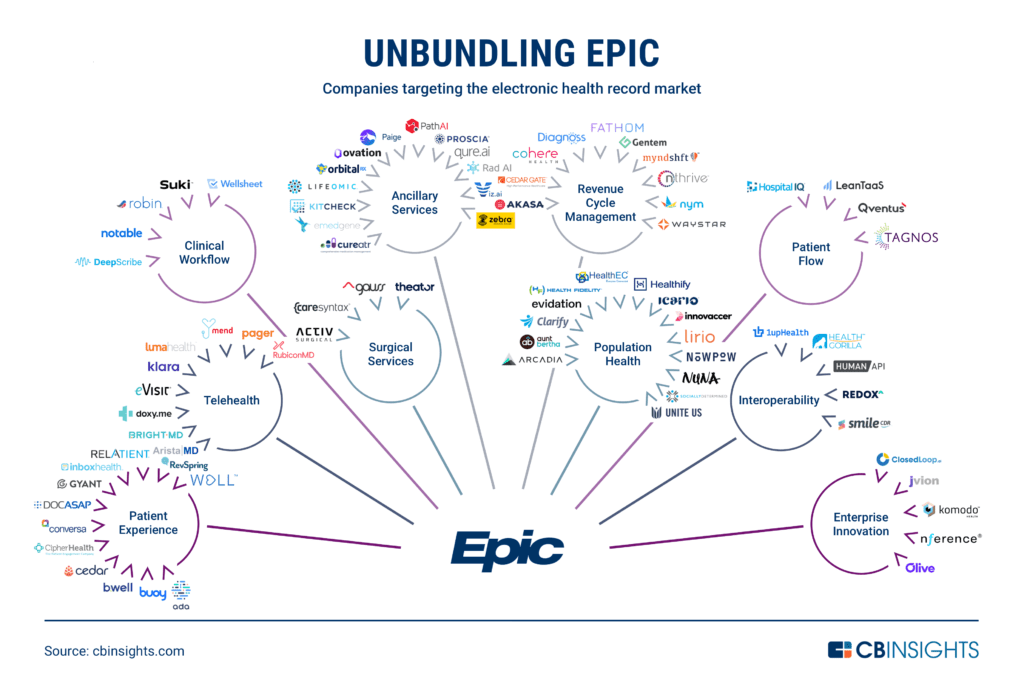
Source: CB Insights – The fragmentation of EMR systems as vendors add point solutions.
But this piecemeal approach creates real problems. A mother trying to complete intake forms for her child’s appointment encounters one portal. She logs into a different system to pay her bill. She uses a third platform to message the doctor. Each system asks for her address again. Each requires a different password.
She gives up. She calls the front desk. Your staff walks her through each step over the phone, adding 15 minutes to their workload and 15 minutes of frustration to her day.
This fragmentation does more than waste time. It damages the relationship between patients and providers before care even begins. Patients who struggle with digital tools feel unseen. They wonder if anyone cares whether their experience is difficult. Many stop engaging entirely.
Poor portal experiences drive patients away. They miss appointments because reminders went to a platform they stopped checking. They delay care because the payment process felt too complicated. They choose other providers whose digital experience feels less hostile.
Your clinical staff never sees most of this erosion. They just notice the empty appointment slots and the patients who don’t return.
The Hidden Cost of Disconnected Systems
Multiple vendors create obvious financial costs. Each system carries its own licensing fee. Integration work requires custom development every time you want data to flow between platforms. Many organizations settle for minimal integration just to control expenses, which means the systems never truly connect.
But the human costs run deeper.
Front desk staff spend hours on the phone helping patients navigate systems that should be self-service. They re-enter information that patients already provided because the intake platform doesn’t talk to the EMR properly. They apologize for technical problems they didn’t create and can’t fix.
This burden contributes directly to staff burnout. Your team chose healthcare because they wanted to help people. Instead, they’re troubleshooting software and explaining why patients need yet another login.
Patients experience their own version of this frustration. They encounter different authentication methods across platforms. Some systems require complex passwords. Others use weak security based on birth dates and addresses. None of it makes sense, and all of it feels like the organization doesn’t value their time.
When patients can’t complete basic tasks online, they disengage. Research shows 75% of patients want technology-based healthcare. But they want technology that works. Clunky portals train patients to pick up the phone instead, which defeats the entire purpose of digital access.
More Touchpoints. Zero Friction.
Imagine a different experience. A patient receives an appointment reminder with a link. That link opens intake forms tailored to their visit type. They answer questions about their current symptoms, update their insurance information, and complete any necessary consent forms. The system already knows their address and medical history, so they don’t re-enter information they’ve provided before.
While completing intake, they see their outstanding balance. They pay it using a saved payment method. The system asks a few questions about their living situation: do they have reliable transportation to appointments, do they have enough food at home, do they feel safe where they live. These social needs questions appear naturally as part of the check-in process, not as a separate screening they need to complete elsewhere.
All of this happens in one system. One login. One smooth flow from reminder to check-in to payment to social screening. The patient finishes in five minutes. They arrive at their appointment with everything already completed. Your staff greets them and takes them straight back.
This is what zero friction looks like. It doesn’t eliminate touchpoints. It connects them. The patient interacts with your organization multiple times, but each interaction feels intentional rather than redundant.
The clinical value extends beyond convenience. When social drivers of health screening happens during routine intake, you capture information about transportation barriers, food insecurity, and housing instability. You identify patients who need referrals to community resources. You address upstream factors that affect health outcomes before they create medical crises.
This approach treats the whole person, not just their presenting symptoms. It acknowledges that healthcare happens in the real world. A patient who can’t afford groceries won’t manage their diabetes well no matter how good your clinical protocols are. A patient who lacks transportation will miss follow-up appointments.
Capturing this information during intake doesn’t add burden. It reduces it. Patients answer questions once as part of a process they were already completing. Staff receives complete information without making separate phone calls to screen for social needs.
Cut Costs. Not Connections.
Healthcare organizations face constant pressure to reduce expenses. The instinct is often to cut staff, limit services, or reduce the time spent with each patient. These approaches do cut costs. They also cut the human connections that make care effective.
There’s a better way. Consolidating multiple vendors into one platform reduces licensing fees immediately. Organizations typically pay separate fees for patient intake, bill payment, messaging, appointment scheduling, and portal access. A unified system eliminates most of these redundant costs.
But the bigger savings come from workflow efficiency. When staff doesn’t spend time on duplicate data entry, phone support for portal problems, and reconciling information across systems, they have capacity for work that actually matters. Front desk hours decrease without reducing quality. Administrative burden drops without making the patient experience worse.
This is the key principle: the right technology should preserve and enhance human connection, not replace it. Digital intake that works well gives patients more control and gives staff more time. Both groups benefit.
The data supports this approach. Organizations using unified intake platforms see 70% of patients complete check-in before arrival. Time-of-service collection rates for copays and outstanding balances reach 85%. Social needs screening rates climb to 60%, with 40% of those screened receiving referrals to helpful services.
Patient satisfaction scores tell the clearest story. When patients rate how “heard” and “cared for” they feel during check-in, scores rise from 3.7 to 4.6 out of 5 after switching to integrated systems. The technology makes them feel more connected, not less.
Digital Empathy Is Real Empathy
There’s a persistent myth that digital healthcare is inherently cold. That automation means losing the human touch. That efficiency comes at the expense of compassion.
This myth assumes bad digital experiences are inevitable. They’re not. Poor digital experiences come from poor design, not from digitization itself.
Digital empathy means building systems that respect how people actually think and behave. It means asking for information once and remembering it. It means explaining clearly why you need sensitive information instead of just demanding it. It means acknowledging that a patient arriving at your office has already invested effort in getting there, so your intake process shouldn’t waste their time.
When done well, digital tools amplify empathy. They free staff from repetitive tasks so they can focus on moments that require human judgment and compassion. They give patients control over when and how they interact with the healthcare system. They capture information about social needs without forcing patients to disclose struggles in a waiting room.
Consider what it means for a patient to be asked about food insecurity. In person, that conversation requires vulnerability and trust. Many patients won’t answer honestly. But a well-designed digital screening asks the question privately, explains why it matters, and immediately offers resources if needed. The patient feels cared for, not judged.
This is empathy delivered through technology, not in spite of it.
What True Integration Delivers for Patients and Staff
True integration is not about connecting multiple separate systems. It’s about building one system that handles multiple functions. There’s a meaningful difference.
When you connect separate systems, data flows between them, but each system still operates independently. Updates in one place eventually appear in others, sometimes with delays. Patients still experience transitions as they move from intake to payment to messaging. Those seams are where friction lives.
A unified platform eliminates the seams. Intake, payment, social screening, and communication happen in the same environment. The patient never leaves the flow. Data updates everywhere instantly because there’s only one source of truth.
For staff, this means managing one interface instead of five. Learning one system instead of training on multiple platforms. Troubleshooting one set of tools when problems arise. The cognitive load drops dramatically.
It also means collecting better data about the patient experience. When everything happens in one system, you can track the entire journey. You see where patients hesitate, where they abandon tasks, where they need help. You can measure whether changes actually improve outcomes.
This data becomes the foundation for continuous improvement. You send appointment reminders at times when patients actually open them. You adjust intake questions based on completion rates. You identify which payment options patients prefer. The system learns and adapts.
Building a Better Front Door
Healthcare organizations shouldn’t have to choose between efficiency and humanity. Between reducing costs and maintaining quality. Between digital convenience and personal connection.
The right platform delivers all of these simultaneously. It makes life easier for patients and staff. It reduces expenses while improving satisfaction scores. It automates routine tasks while preserving space for meaningful human interaction.
The shift to digital healthcare is permanent. Patients expect online access to their health information. They want to complete administrative tasks on their own schedule. They will use digital tools if those tools actually work.
The question facing healthcare organizations is not whether to offer digital services. It’s whether those digital services will strengthen or weaken the relationship between patients and providers.
Fragmented systems weaken that relationship. They frustrate patients, burden staff, and create barriers to care. Every unnecessary login is a message that the organization doesn’t value the patient’s time. Every redundant data entry is a sign that systems matter more than people.
Unified systems strengthen the relationship. They demonstrate respect through design. They make engagement easy. They capture information that helps address the real barriers to health. They create space for the human moments that matter most.
When access works, care works. Patients show up prepared. Staff focus on clinical needs instead of administrative fixes. Social needs get identified and addressed. Everyone involved feels heard, valued, and supported.
That is the standard digital healthcare should meet. Functional and genuinely helpful. Efficient and empathetic. Modern and meaningfully better for everyone involved.
A digital front door that welcomes everyone who walks through it.
